Garden of Remembrance

SF State exhibition examines legacy of Japanese American incarceration

Fine Arts Gallery presents new artwork reflecting on Ruth Asawa’s Garden of Remembrance on campus 

Eighty-two years ago, Japanese American students from San Francisco State College were forced to withdraw from classes, some taken to prison camps. Twenty-two years ago, San Francisco State University dedicated a garden to honor the Japanese American experience of incarceration during World War II, especially that of the 19 students, and the resilience of this community after their release, designed by acclaimed artist Ruth Asawa. This year, the garden is the subject of further artistic exploration in new works on display in the Fine Arts Gallery on campus. 

“Reflecting on Ruth Asawa and the Garden of Remembrance” features new commissioned works by artists Mark Baugh-Sasaki, Tina Kashiwagi, Paul Kitagaki Jr., Lisa Solomon and TT Takemoto.  

The exhibition opens on Saturday, Feb. 24, with a reception from 1 to 3 p.m., and concludes on Saturday, April 6. The Fine Arts Gallery is open Tuesdays – Fridays, noon – 4 p.m. Admission is free. 
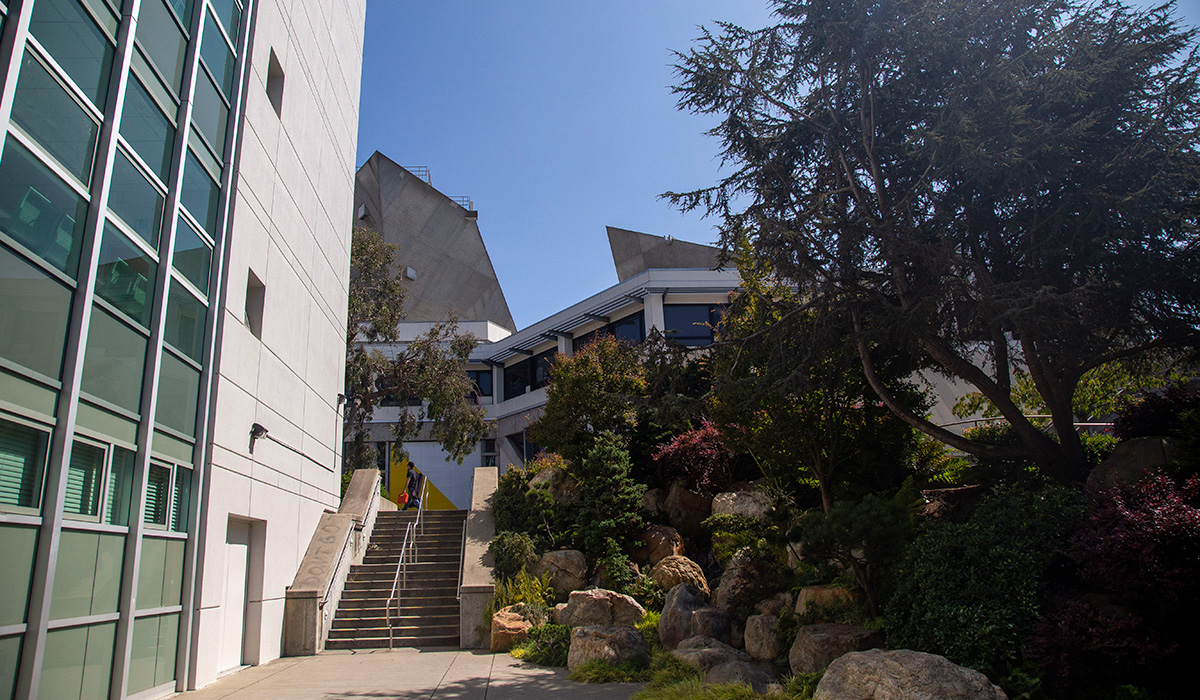
 The Garden of Remembrance by Burk Hall and the Cesar Chavez Student Center on a sunny day

Dedicated in 2002, the Garden of Remembrance is located between Burk Hall and the Fine Arts building. A waterfall cascading from behind the Cesar Chavez Student Center signifies the return of the internees to the coastline after the war. Ten large boulders in the grassy area next to Burk Hall represent each of the camps set up during World War II. The names of the 19 former SF State students expelled and the names of the camps are listed on a bronze, scroll-shaped marker. The marker also includes reproductions of official government documents regarding the internment. 

In an essay for the exhibition’s catalog, artist and cultural producer Weston Teruya describes “Reflecting on Ruth Asawa and the Garden of Remembrance” as a “relationship of care” to family, community and shared stories. 

“This collection of artworks is an intergenerational remembrance: a deep sensory reflection on ancestral practices and cultural traditions that are studied across veils of time and oceans, and the unearthing of elided histories and traumas from beneath stone memorials or out of the recesses of overlooked archives,” Teruya writes. 

“Reflecting on Ruth Asawa and the Garden of Remembrance” is supported by the National Endowment for the Arts, The Henri and Tomoye Takahashi Charitable Foundation, the Andy Warhol Foundation for the Visual Arts and SF State’s Instructionally Related Student Activities Fund. 

Learn more about the “Reflecting on Ruth Asawa and the Garden of Remembrance” exhibition

Internment camp victims honored in Garden of Remembrance

Students, professors, activists and those standing in solidarity with the Japanese-American community gathered Feb. 19 for the 40th anniversary of the Bay Area’s first Day of Remembrance, honoring the more than 100,000 Japanese-Americans who were forcibly relocated to internment camps in California, Oregon and Washington during World War II.

The event took place at the Garden of Remembrance, an installation dedicated to the 19 SF State students who were among those interned by authority of an Executive Order signed Feb. 19, 1942, by President Franklin D. Roosevelt in the wake of Japanese attacks on Pearl Harbor.

Seventy-seven years later, attendees at the event hosted by the Asian American Studies department and Arab and Muslim Ethnicities and Diasporas (AMED) study program stood in the early-evening chill and listened to the burbling of the garden’s waterfall as they held a moment of silence to pay tribute to the SF State students swept up in the U.S.  government’s racist attack on Japanese-Americans.

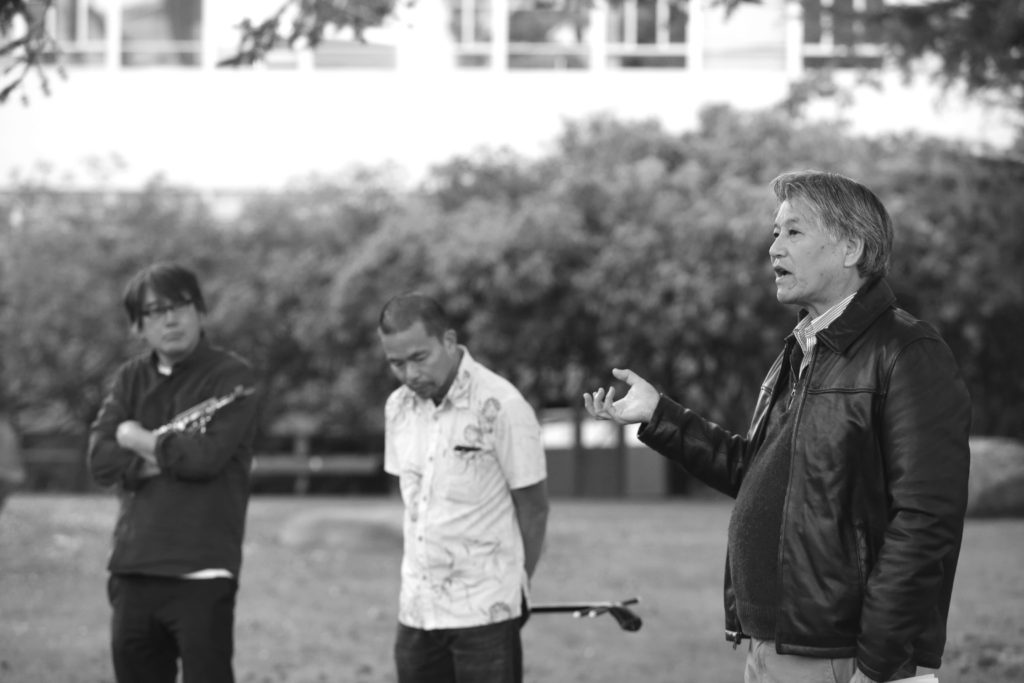
They then formed a circle in a grassy area of the Garden of Remembrance, holding small LED-candle lights as AAS professors Francis Wong and Wesley Ueunten played music on a saxophone and a three-string guitar called a sanshin.

The commemorative garden, located in a quiet nook between the Creative Arts Building and Burk Hall, was designed by former camp internee Ruth Asawa in 2001 and funded by a $125,000 grant from the California Civil Liberties Public Education Program. It’s adorned with 10 boulders of varying sizes to represent the largest of the concentration camps and the dry, desert-like land they were situated on.  The boulders contrast with the waterfall that marks the internees’ return to their homes on the Pacific coast after regaining their freedom in 1945.

“Let us remember the people who were incarcerated and lift up the presence of their spirits amongst us,” human rights advocate Rev. Michael Yoshii said.

Asawa designed a bronze marker inscribed with the names of the internees, their family crests and the names of the camps in which each was incarcerated. Yoshii spoke to those gathered about his part in the movement of the early 1980s that sought redress and reparations from the U.S. government for the wartime internment of Japanese-Americans like his grandparents.

Born after World War II, Yoshii became heavily involved in bringing justice to the Japanese-American community. When he first joined the Buena Vista United Methodist Church, he sought to make it a place that welcomed newly-arriving immigrants and served as a place of safety and activity for those who were interned.

Tuesday he talked about his involvement in the movement that led to the 1981 congressional hearings to investigate the injustices committed against Japanese-Americans by the U.S. government. He took part in three days of hearings in San Francisco where survivors and loved ones testified about the horrors perpetrated on their communities and the psychological damage they suffered.

“Day of Remembrance is not just remembering the history of pain and the trauma that our communities went through,” said Director of the Japanese Peruvian Oral History Project, Grace Shimizu. “[It’s] also to fight back [and] to hold the government accountable.”

The hearings prompted Congress to pass the 1988 Civil Liberties Act and to write a letter of apology to the victims of the U.S. government’s concentration camps.

“There was a lot of trauma that took place during the incarceration that continued to last,” Yoshii said. “It was not an easy thing to talk about.”

The legislation also formed the Office of Redress Administration, which Congress tasked with coordinating a 10-year program to compensate victims of the internment camps with reparation checks of $20,000.

“That letter didn’t solve everything and the checks don’t rectify everything,” Yoshii said. “Many people said this is a small token to what we really lost.”

AMED studies Director and professor Rabab Abdulhadi, who co-organized the event, was also present to lend her support to the community. She said even the strongest people who’ve been tortured have difficulty speaking and reliving the past, which makes the struggles the communities are currently facing even more important.

“If we don’t tell the stories, people will not remember,” she said.

Michael Yoshii speaking to event attendees

Rev. Michael Yoshii (right), a human rights activist, speaks to a group as Asian American studies professors Francis Wong (left) and Wesley Ueunten (center) listen on during Day of Rememberance, Tuesday, Feb. 19, 2019. Photo by: James Chan (Golden Gate Xpress)

Among those who stood in solidarity with the Japanese-American community was Zahra Billoo, the executive director of the Council on American-Islamic Relations. Billoo has worked closely with Dr. Abdulhadi over the years, and she talked about her experiences and fears in the wake of Sept. 11.

“I remember thinking, ‘Am I safe in my own skin?’” Billoo said. “I also remember the Japanese-American community stepping forward very quickly. They said they know exactly how this goes and, ‘We’re not willing to let this happen to you the way it happened to us.’”

Yoshii, too, connected the attacks on the Japanese American community during World War II with the treatment of African-Americans during the Civil Rights Movement and the vilification of Arabs and Muslims after the 9/11 terrorist attacks.

“[The internees’] journey continues to inform our journey today regardless of where we are and who we are,” Yoshii said.

Yoshii also read statements by members of the Asian American, Native Hawaiian and Pacific Islander communities in solidarity with Palestinian people, the Boycott Divestment Sanctions, professor Abdulhadi and AMED studies.

S.F. State honors internees from World War II

Sixty years after they were forced off campus and moved into wartime internment camps, Helen Hori and Kaya Sugiyama returned to San Francisco State University yesterday — as treasured guests.

The university unveiled a new memorial and waterfall garden to honor the experience of the more than 120,000 Japanese Americans held in internment camps during World War II.

The memorial pays special tribute to Hori and Sugiyama, and 17 other San Francisco State students forced to leave.

"It's very special," said Hori, 83, who was Helen Nitta before she married. "Most of us like to have the public know what happened."

The memorial, tucked away in a quiet courtyard, tells their story with stone and water.

Ten large boulders sit on a grassy lawn, representing each of 10 internment camps set up during the war in California, Arizona, Idaho, Utah, Wyoming, Colorado and Arkansas. A waterfall, surrounded by boulders and a flowering garden, symbolizes the internees' freedom and return after the war.

A bronze plaque includes a map of the 10 internment camps, a list of the 19 San Francisco State students who were forced to withdraw and copies of the executive order allowing the confinement of Japanese Americans signed by President Franklin Roosevelt.

The memorial was financed by a $125,000 grant from the California Civil Liberties Public Education Program.

Ruth Asawa, a San Francisco artist and former internee, designed the memorial and garden as a way of informing future generations of students who may know little about the internment camps.

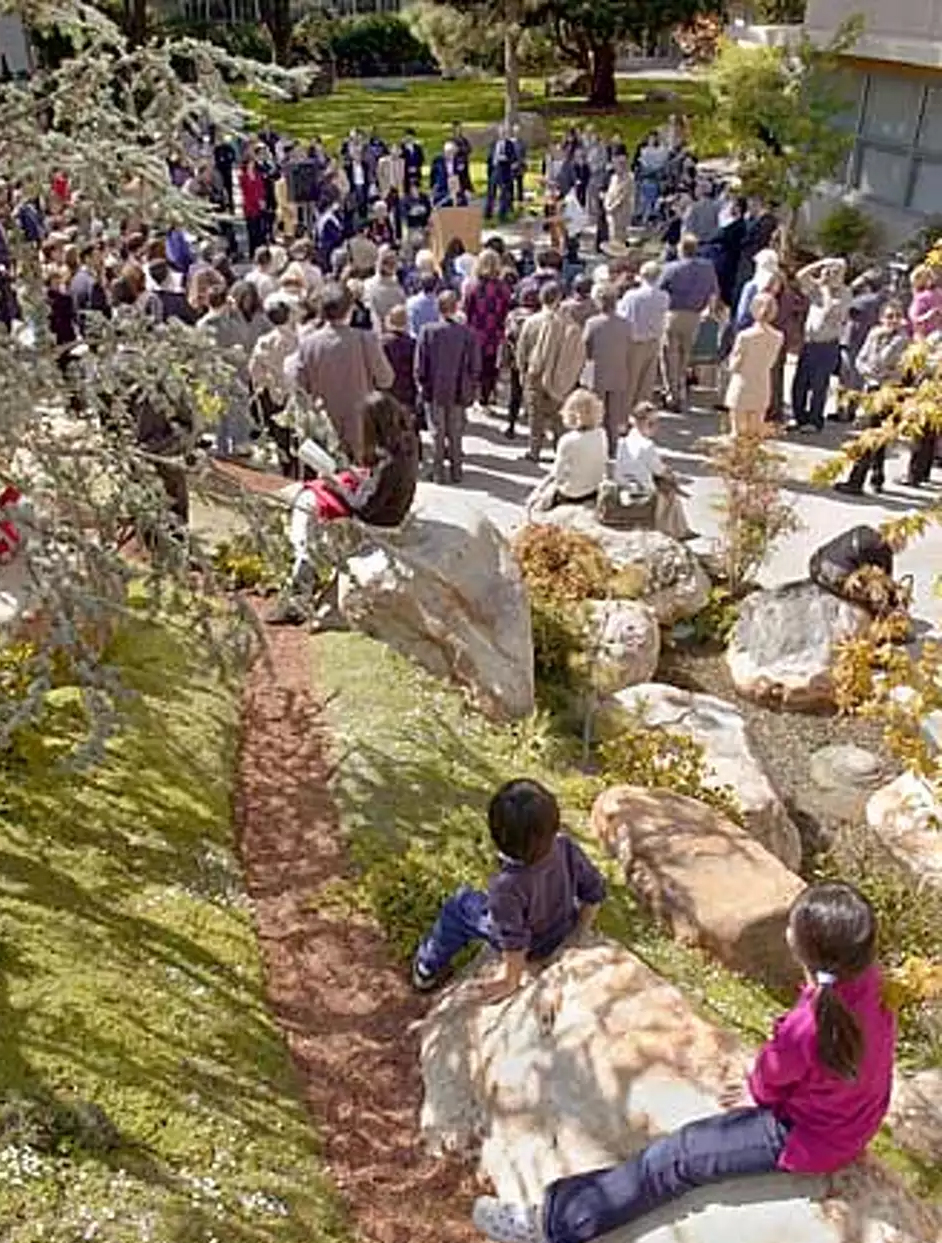
Aerial shot of people congregated in the Garden of Remembrance

Dedication of a memorial garden at San Francisco State honoring Japanese American students that were interned during World War 2. Photo by: John Storey.

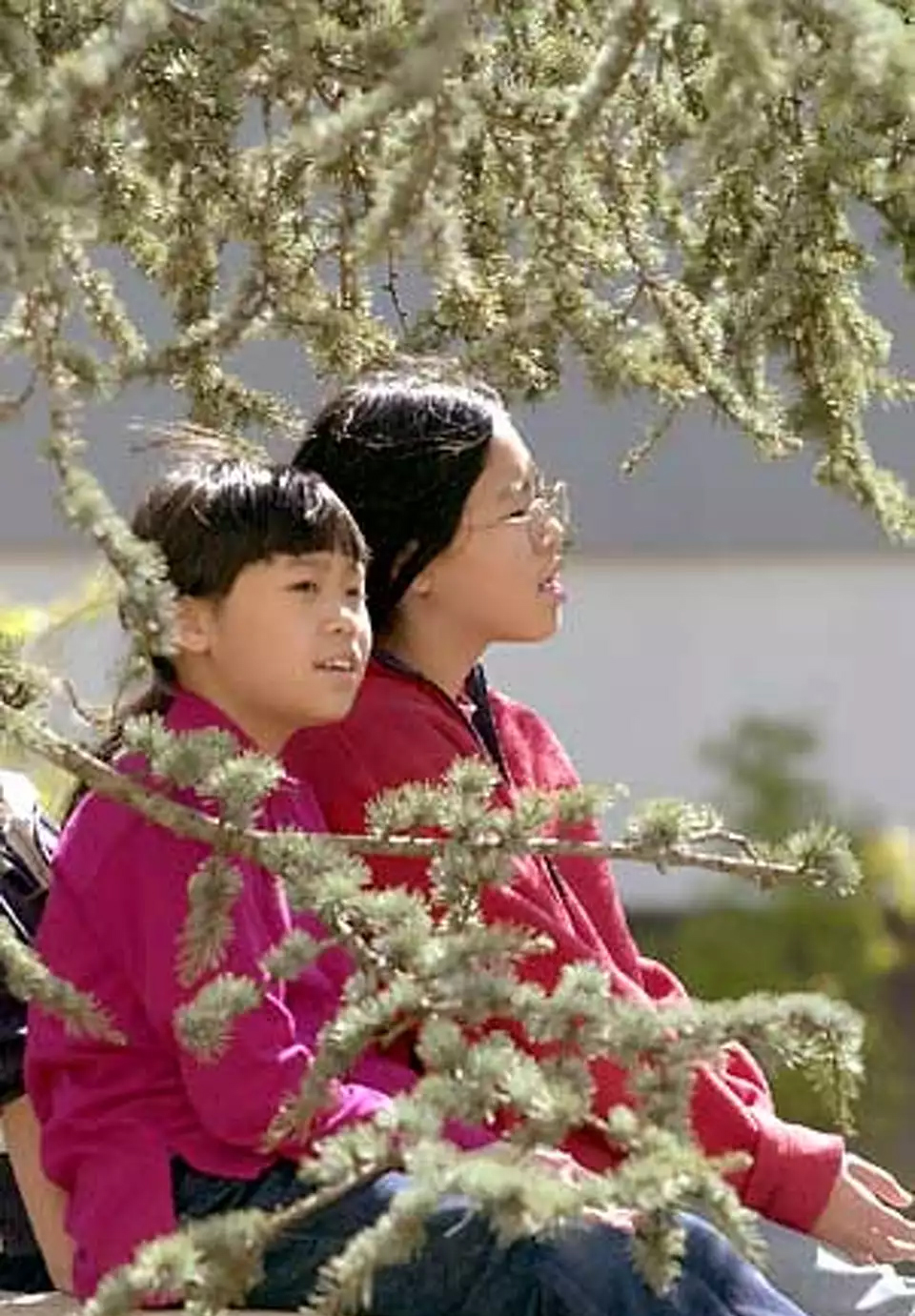
Two girls sitting on a rock

Amanda Lee (right), 11, and her sister Clarissa Lee, 9, watch the dedication ceremony from the garden. Photo by: John Storey.

"I thought it would be nice if we could do something that told the story, but not in a bitter way and not just as a Japanese story," said Asawa, who was 16 when she was ordered into an internment camp in Rowher, Ark. "This is a story about liberty and freedom."

Sugiyama, 80, recalled the "cruel" way her family's life was interrupted. She was a 20-year-old music major when she was forced to drop out of college.

Her parents left their home in San Francisco, and the family initially was moved into a horse stall at Tanforan Race Track in South San Francisco. The stall had been used by the legendary "Sea Biscuit."

"You just don't have time to think," she said. "We just had to leave."

While her parents and younger siblings were later moved to the camp in Topaz, Utah, Sugiyama and her brother went to the University of Colorado. It was the only college west of the Mississippi, she said, that would accept Japanese American students.

Still, Sugiyama said, she was extremely lucky her father, a doctor, could afford to pay Colorado's tuition. Most of her peers had to postpone college. And some never went back.

In Colorado, Sugiyama and her brother were kept under government surveillance for six months. Eventually, she was hired as a part-time conversational Japanese teacher for military personnel.

After the war, she returned to California. Here, she said, she still encountered insults, including on the job as a child care worker.

"Kids would say they wouldn't take crap from Japs," she recalled. "I just rebelled. I would tell them all to go to hell."

Hori, a college junior and education major in 1942, had tried to stay in classes as long as she could.

When she was finally forced to leave in May, she needed a special permit to travel to her parents' farm in Placer County.

They all were sent to the camp at Tule Lake near the California-Oregon border. Like Sugiyama, she also taught conversational Japanese. Later, she moved to Indianapolis, but could find work only as a secretary because she hadn't finished school.

Years later, after she had married, Hori did return to San Francisco State, where she received her teaching degree. She became one of the first Japanese American teachers in the San Francisco city schools, and finally retired in 1985.

In 1998, San Francisco State granted honorary degrees at a special graduation ceremony to the 19 Japanese American students who had been forced to leave.

Aiko Nishi, who had been a 19-year-old education student when she was interned, was thrilled to be honored then, said her daughter, Vivian Nelson.

Nelson attended yesterday's ceremony on behalf of her mother, who died last year.

Afterward, tears filled her eyes as she pointed to her mother's name on the memorial plaque.

"I wish she could have been here to see this," she said. "It's just nice to see that your mom is remembered."

Japanese-Americans interned during World War II honored by SFSU

Nearly 300 people gathered today for the dedication of the Garden of Remembrance, a permanent campus memorial honoring Americans of Japanese ancestry who were sent to internment camps during World War II.

President Robert Corrigan led the ceremony with an introduction that reminded the audience of the memorial's purpose.

"We have gathered here — some of you travelling from as far as our Sister City of Osaka — to acknowledge the past, honor those our nation wronged, and rededicate ourselves to a future in which such things will never — never — be repeated,"  Corrigan said.

A purification ceremony for the garden, located in the courtyard between Burk Hall and the Fine Arts building, followed the President's introduction. Mayor of Osaka Takafumi Isomura, Consul General of Japan Shigeru Nakamura, California State Librarian Kevin Starr and Japanese American community members were among those who attended the ceremony.

In particular, the memorial recognizes 19 Japanese-American students forced to withdraw from their classes at SFSU in 1942 to be interned in camps. Two of these former students, Helen (Nitta) Hori and Kaya Ruth (Kitagawa) Sugiyama, both San Francisco residents, attended the ceremony. 

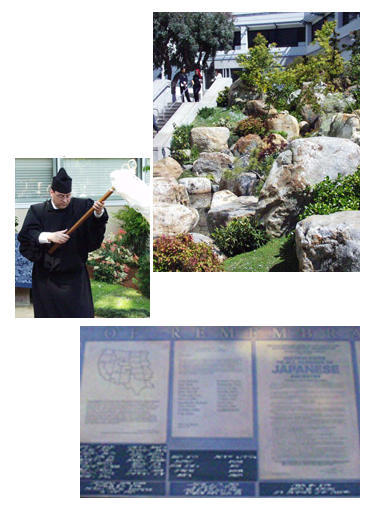
The central piece of the memorial is a waterfall designed by renowned Japanese-American artist Ruth Asawa, a former camp internee, that signifies the return of the internees to the coastline after the war. Ten large boulders in the grassy area next to Burk Hall represent each of the camps set up during World War II. The names of the 19 former SFSU students who were interned and the names of the camps are listed on a bronze, scroll-shaped marker. The marker also tells the story of the internment through official documents.

This is not the first time SFSU has recognized the 19 students who were taken to internment camps. In 1998, they received honorary degrees, as did Asawa.

The waterfall, a purification ceremony, and a close up of the scroll.

Garden of Remembrance honors 19 former SFSU Japanese students interned during World War II

Construction has begun on a permanent memorial and waterfall garden at San Francisco State University to honor all Americans of Japanese ancestry who were sent to American-style concentration campus interned during World War II.

Renowned Japanese American artist, teacher and former camp internee Ruth Asawa will design the Garden of Remembrance. The memorial will honor the 19 Japanese American students who were forced to withdraw from classes at SFSU in 1942 and taken to internment camps.

"It is important for us as a University community to recognize a terrible injustice inflicted upon loyal American citizens and remind ourselves, our students and community, of our shared responsibility to uphold the rights of all people at all times," said President Robert A. Corrigan. "We also want to acknowledge our alumni who for no other reason than their ancestry were denied a college education at the time and to remember them in perpetuity as esteemed members of our University family."

Asawa, a San Francisco-based artist whose pieces are displayed at such as places as the University of California Medical Center, the Japanese American Internment Memorial for the Federal Building in San Jose, the rededicated fountains in San Francisco's Japantown, Ghiradelli Square and Bayside Plaza near the Embarcadero, developed her love for art during a year-long incarceration in the Rowher, Ark. internment camp. This memorial, she said, allows students to contemplate in a serene setting the horrible acts that took place years ago.

"A lot of students don't know about the internment camps. They believe that it doesn't affect them but I think it's important that they recognize what took place," said Asawa, who was 16 and a high school junior in Norwalk, Calif. when she and her family were ordered into the camps during the spring of 1942. "I thought it would be nice if we could do something that told the story but not in a bitter way and not just as a Japanese story. This is a story about liberty and freedom."

The memorial and waterfall will be located in the serene courtyard between Burk Hall and the Fine Arts Building. Once completed it will be the largest and most extensive permanent memorial on the University's campus.

Ten large boulders will be selected to represent each of the 10 internment camps set up during World War II. The stones symbolize the deprivation of the camps that were located in dry desert-like places. In contrast, a waterfall will be created to signify the return of the internees to the coastline after the war. Placed nearby will be benches where students and visitors can sit and take in the setting.

At 7 feet long and 22 inches high, the bronze marker shaped as a scroll will bear the names of the camps and the family crests of the families whose children were among the SFSU students interned. The marker will also tell the story of the internment through official documents.

"I want this memorial to be very pleasant and a place for people to gather, to think and to enjoy," said Asawa, who was awarded an honorary degree from San Francisco State University in 1998.

Assisting Asawa with design and construction of the project is Isao Ogura and Shigeru Namba of the Professional Gardeners Federation of Northern California. Phil Evans, director of campus grounds, and Mark Johnson, director of the art gallery, have also worked closely with Asawa, Ogura and Namba.

Construction will continue at the site in coming months and the memorial garden will be dedicated in a public ceremony in spring 2002.

The Garden of Remembrance is made possible by a $125,000 grant from the California Civil Liberties Public Education Program. To make a donation to the garden, contact Rebecca Thompson in the Office of University Development at (415) 405-3642.

One of the largest campuses in the California State University system, SFSU was founded in 1899 and today is a highly diverse, comprehensive, public and urban university.